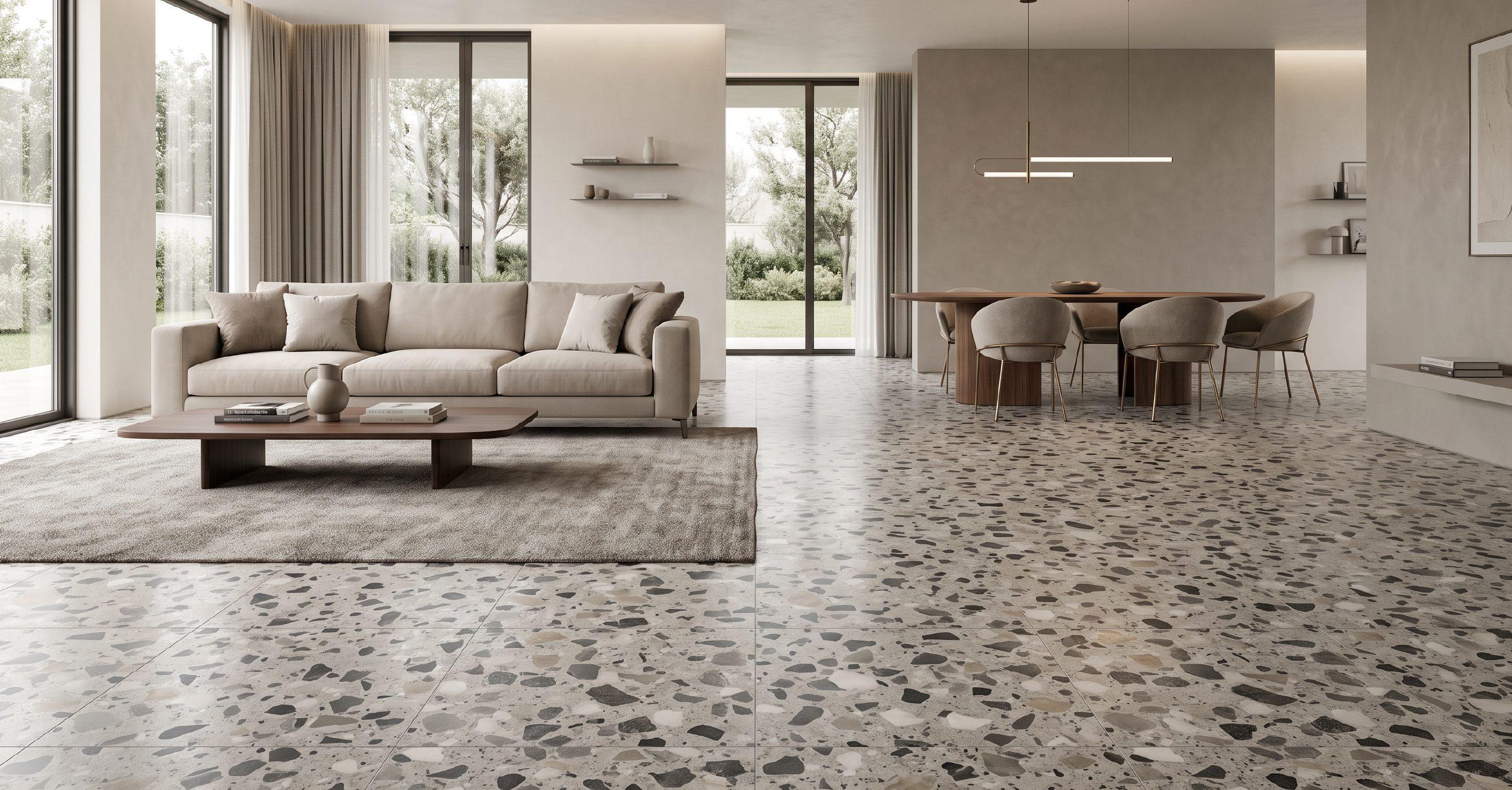
If there is one interior surface that deserves more attention in 2026, it is the floor.
For years, flooring was treated as the backdrop to a room. Pick something durable, choose a colour that works, and move on to the furniture. That approach is changing. Designers are increasingly using the floor to establish mood, introduce texture, create visual rhythm and even define how a space is used. Architectural Digest India recently described flooring as a considered design decision that can anchor furniture, circulation and the material palette of an entire room.
Globally, the direction is equally clear. The tile world is moving towards warmer colours, tactile surfaces, natural-looking materials, expressive patterns and more thoughtful use of scale. The 2026 trends presented by Coverings, the international tile and stone exhibition, place particular emphasis on texture, dimensional surfaces and material character.
For Indian homes, these trends become even more interesting when combined with practical considerations such as heat, monsoon, dust and everyday family life.
So, what should you be looking at in 2026?
1. Large-Format Tiles That Let The Room Breathe
Large-format flooring is hardly a new idea, but in 2026 it is becoming more refined.
Fewer grout lines create a softer, more continuous surface, allowing the architecture and furniture to take centre stage. In an open-plan living and dining area, large tiles can visually connect the two zones rather than breaking them into smaller sections.
Marble-look porcelain and vitrified tiles are particularly effective here, giving you the visual scale of stone without necessarily committing to natural stone.
The key is proportion. Large tiles work best when their size complements the room rather than being chosen simply because bigger feels more premium. Indian tile trends for 2026 continue to highlight large formats as a way of creating a more seamless visual field.
Best for: Living rooms, dining areas, master bedrooms and open-plan interiors.
2. Warm Neutrals Are Replacing Cold Greys
The grey-everything era is gradually giving way to something warmer.
Think sand, cream, beige, taupe, honey, terracotta and muted earthy tones. These colours create interiors that feel softer and more inviting, particularly when paired with wood, natural fabrics and greenery.
This is not about making every room beige. It is about moving towards colours that feel connected to natural materials.
Current global tile collections are showing stronger interest in earth, spice, water and sky-inspired palettes, while Indian tile trends are also highlighting warm beige, cream, terracotta and muted sage.
For Indian homes, these shades also have a practical advantage: they tend to sit comfortably with the warm quality of natural daylight.
3. Natural Stone Looks, Without The Fuss
Natural stone has always had a place in architecture. What is changing is how convincingly tile can recreate its depth, movement and imperfections.
Marble, limestone, travertine, slate and other stone-inspired surfaces are becoming increasingly sophisticated. Rather than looking like a printed image on a tile, newer designs focus on tonal variation, veining and texture.
This gives you the visual language of natural stone with the practical benefits associated with manufactured tile.
And there is something particularly appealing about stone-inspired flooring in a home. It feels grounded without demanding attention.
Design tip: Look for variation rather than repetition. The more naturally the pattern flows from one tile to the next, the more convincing the overall floor will feel.
4. Matte Finishes Are Having Their Luxury Moment
High gloss is making room for something softer.
Do you know Matt finish tiles absorb light rather than throwing it back, creating a calmer and more tactile surface. They work particularly well with natural stone looks, warm neutrals and minimalist interiors.
This is also a practical direction for Indian homes. Matt surfaces can be more forgiving of everyday footprints and dust than highly reflective floors, while appropriately textured finishes can be useful in areas where slip performance matters.
The global design conversation is increasingly favouring tactile, low-sheen surfaces over slick finishes. Coverings’ 2026 trends specifically highlight texture and tactile appeal, while Indian tile trends point towards matte finishes as a more sophisticated alternative to high gloss tiles.
The result is understated rather than plain.
5. Terrazzo Is Back, But Softer
Terrazzo has returned, but it is not quite the loud, high-contrast terrazzo you may remember.
The 2026 version is gentler: warmer backgrounds, softer aggregates and more restrained colour combinations. Instead of dominating the room, the tiny fragments create movement across the floor.
That makes terrazzo surprisingly versatile. It can bring personality to a kitchen, dining area or entrance while still working with simple cabinetry and furniture.
Design coverage in 2026 points towards terrazzo becoming more relaxed and adaptable, particularly in warm, neutral palettes.
For a home that wants some pattern without committing to a strong geometric design, terrazzo can be the middle ground.
6. Pattern Is Becoming More Personal
Patterned floors are not going anywhere. But the trend is moving away from simply picking a decorative tile and repeating it everywhere.
Designers are playing with scale, direction, colour combinations and laying patterns to create floors that feel almost custom-designed.
Checkerboards, geometric compositions, stripes, herringbone-inspired arrangements and textile-like motifs are all appearing in contemporary tile design. Cersaie-related coverage has also highlighted textile-inspired patterns, including trellis, stripes and geometric motifs, showing how far tile has moved beyond conventional layouts.
For Indian homes, this could mean a patterned entrance, a statement dining floor or a decorative bathroom rather than an entire house of patterns.
The trick is knowing where to stop.
7. Tonal Checkerboards Instead Of Classic Black And White
Checkerboard is still around, but it is getting a more sophisticated update.
Instead of stark black and white, designers are using cream and taupe, beige and brown, soft grey and stone, or two related marble tones.
The result retains the graphic quality of a checkerboard without feeling overly retro. Current design coverage describes softer, matte and muted versions as a more contemporary interpretation of the classic pattern.
You can also change the scale. Oversized checks can feel architectural, while smaller ones create a more decorative effect.
A tonal checkerboard can be particularly effective in an entrance, kitchen or bathroom where the floor is meant to establish the mood immediately.
8. Texture Is Moving From Detail To Feature
Tile no longer has to be visually flat.
Three-dimensional surfaces, striations, ridges, pitted textures and tactile finishes are becoming a major part of the 2026 tile conversation. Coverings describes this direction through its “Articulated Accents” trend, where manufacturing techniques create surfaces that respond to both light and touch.
For floors, this can translate into stone-like textures, subtle relief and surfaces that create movement without relying on strong colour or pattern.
It is a particularly good option if you like minimalist interiors but find completely plain flooring a little too predictable.
9. Mixed Materials And Mixed Patterns
One floor does not necessarily have to look like one floor.
Designers are becoming more playful with combinations of materials, colours and tile layouts. Different surfaces can be used to define zones within an open-plan home, while contrasting tiles can create borders or “rugs” within the floor itself.
Indian design has its own beautiful history of this approach. Architectural Digest India recently highlighted contemporary homes using Kota stone in geometric inlays and terrazzo-like compositions, showing how traditional materials can be reinterpreted through modern layouts.
This is particularly useful when you want to visually separate a dining area from a living room without putting up a wall.
Think of the floor as a plan, not just a surface.
10. Floors With A Sense Of Craft
Perhaps the biggest shift of all is towards flooring that feels less mass-produced.
Handmade references, artisanal surfaces, irregular edges, tonal variation and imperfect-looking finishes are becoming increasingly desirable. Even when the tile itself is manufactured, the design can borrow the visual character of something made by hand.
This reflects a wider move towards interiors that feel personal rather than perfectly coordinated. Global 2026 tile coverage repeatedly points to craftsmanship, material authenticity and individuality as important design directions.
For homeowners, that could mean choosing a floor with subtle variation rather than one that repeats with absolute uniformity.
After all, a home should feel lived in, not digitally rendered.
Which 2026 Tile Trend Should You Bring Home?
The most interesting thing about these trends is that they are not really about following trends.
They are about choosing more thoughtfully.
A large-format stone look might be perfect for someone who wants a calm, seamless home. Someone else might prefer a terrazzo floor that brings a little movement into the kitchen. A warm matt tile could make a bedroom feel instantly more inviting, while a tonal checkerboard could give a compact entrance its own identity.
And you do not have to choose just one.
The strongest interiors often combine these ideas: warm colour with natural texture, large formats with subtle variation, or a floor with one carefully considered pattern.
Design Beyond The Trend
A tile is not a temporary accessory. It becomes part of the architecture of your home, which is why the best trend is ultimately the one that still feels right years from now.
Think about the light in your home. Think about how the room is used. Look at the tile with your furniture, walls and other materials. And always consider how a sample will look when it is repeated across an entire floor.
At AparnaUnispace, you can explore floor tiles, wall finishes and outdoor surfaces across a wide range of colours, formats, textures and designs. The idea is not simply to find a tile that is trending in 2026, but one that makes sense for your home.
Ready To Find The Floor Your Home Has Been Waiting For?
Explore the latest tile designs at Unispace and discover surfaces that bring together the best of contemporary design, everyday practicality and your own sense of style.